Napoleon's Greatest Dilemma
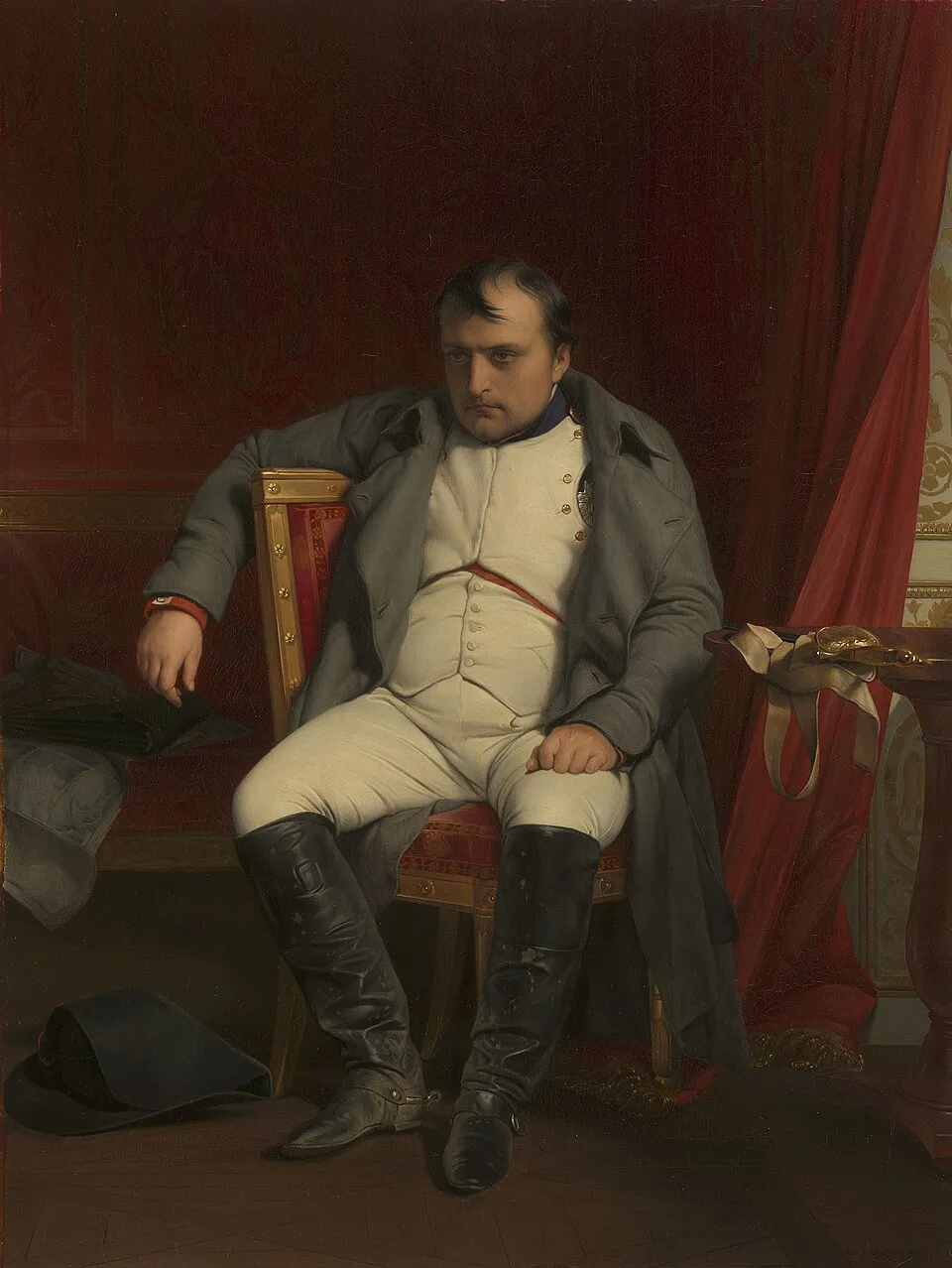
The mist was settling in Austerlitz. Mere shadows of men were transported from their deathplace to their resting-place as Napoleon, le grand homme de La Grande Armée, stood on a hill watching the scene.
But when Berthier—Napoleon’s organizational powerhouse—approached him to celebrate, filling the settling air with rousing words of laudation, he wasn’t met with much happiness. When asked what was the matter, Napoleon coolly replied, “It’s nothing.”
“Are you sure?.”
“Yes, it’s nothing.”
…But it wasn’t nothing. In fact, for several weeks following Austerlitz, Napoleon fell into a deep depression. He no longer walked with his hand in his vest but rather hanging at his side; he was no longer impassioned, enraged, but rather absentminded, apathetic; his face was no longer resolute but rather always looking for something there in front of him that he could not see. It was as if the man had lost himself somewhere in Austerlitz, and indeed that is what had happened. For, while looking at those piles of men being transported from the battlefield, one stacked on top of another, Napoleon suddenly came down with a strong craving for the inexplicably delicious, utterly unique puff pastries that his grand-mère used to make him when he was a little boy. Yes, he doomed himself from the beginning, because it was a craving that could no longer be satiated by his late-grand-mère, who had died some fifteen years prior, bringing the recipe with her to her grave….
“It was the sort of pastry,” he told his closest friend, the great Marshal Jean Lannes, “that one always seeks out in childhood, but never in adulthood—the kind of pastry you forget when life starts to pick up, and that you’ll only remember again in old age, when moments start to slow, and when you realize that you’re so, so far from home. Oh!” He wiped away soft tears. “That pastry Français! Curse these Easterners and their soup! Not un pain au chocolat for miles!”
Initially, the histrionics only peeved his servants. Indeed, Napoleon was so desirous of the fluffy pastry that he enlisted his finest of servants to find the most trustworthy of French bakers to perform the equivalent of a facial composite for the puff pastry, i.e. to recreate the pastry entirely from Napoleon’s description of it. Of course, it never worked, as his descriptors for the pastry were somewhat unsatisfactory, led more by his love for the baked good than by any sort of analysis of its structure, material, and the rest of its Aristotelean four causes. Though he nearly dueled the baker, “a disgrace to the culinary arts,” for his failure to recreate the pastry, all of Napoleon’s relations maintained—in the beginning, at least—that all this was but a fleeting whim, usual with men of Napoleon’s stature.
But then it started to interfere with his performance on the battlefield. At first, the depression-turned-frustration embroiled him in the war. During the Battle of Smolensk, for example, he was so frustrated—overflowing with desire!—that he started to hallucinate. Everywhere he saw éclairs, taunting him in high pitched, girlish voices, “Hahaha! Napoléon, Napoléon, a un désir sans des plaisirs!” He charged after those devilish éclairs ruthlessly, until he couldn’t take it anymore and finally let out, “Back to the oven you go!” And so what happened was, confusing the soldiers and buildings for éclairs, he set the whole town of Smolensk on fire in a fit of rage, realizing only later that he had, perhaps, gotten a bit too carried away by the singing, dancing, endlessly taunting éclairs.
While this won him a victory, it was not lasting, for the Russians started to catch on to the fact that the Emperor had gone mad and lost all tact (as is common for any man who will take on the title “Emperor”). Understanding that mere passion and anger without strategy was an empty hope, the Russ held on knuckle-deep at Borodino and just barely lost, understanding that the more East they dragged the sorry Emperor, the deeper they went into their home and the farther from his, the more would his body tug apprehensively at his mind, not merely for lack of pastries, but for lack of any familiarity with the changing landscape. And so as Napoleon lost his wits over the loss of his grand-mère’s recipe, not thinking for one second about what he was getting his soldiers and himself into, his body lost its strength over the loss of the temperate Western European climate, inching forward into that brutal Russian cold that bewilders without an ounce of familiarity.
But, what’s this? Napoleon’s horse, turning round with the rest of the frozen cavalry and footsoldiers, grasping for a bit of warmth, presses his hoof into the white cold sheet, and there’s that sound: the crunching snow and ice. Napoleon looks down; he notices a few things about the snow that he’d never noticed before. It looks so soft, and yet how strange—when you step into it, it feels hard, and you are forced to sink into it only a little at a time, as though you were stepping on a stack of one thousand jagged, crunchy layers. And just when you think there is no more snow, the hoof continues to shiveringly sink, and, when it hits the ground, though it is so hard, solidified by the cold of the snow, how soft it feels to the foot to get grounding!
"What is this?" Napoleon thinks to himself. "Why, it’s as if the snow, this puffy, fluffy thing, is made of one thousand little layers—one thousand hard, crunchy layers. How can the snow look so puffy, so fluffy, and feel so hard and crunchy? And, the ground! you would think it hard, but it feels so soft once one reaches it, like a nice crème! Why, that’s it! There it is! My own grand-mère’s puff pastry, there in the snow! Oh, but how can I weep and wallow when there is much work to do to keep the memory of this sweet deliciousness alive! Even if it all be in vain, if I can make it to Russia this far, I can make a pastry from my memory!"
“There it is!” he says to himself, looking at the snow. “There it is!”
“What’s he yelling on about?” one of the right-hand men asks Berthier.
“Don’t mind him,” Berthier turns to the right-hand man. “He’s upset.”
“I am not upset!” Napoleon let out.
“He’s mad,” Berthier corrected himself.
Napoleon got right to work with his mother and servants, insisting that they attempt to bake the pastry his grand-mère had mastered in her life to pass it on to the next generation of Frenchmen, Frenchwomen, and Frenchchildren. Of course, there was another year and a half of wars, which he continued merely out of allegiance to his dedicated soldiers and citizens. In truth, it hardly entered Napoleon’s conscious very seriously and seemed to work itself out on its own.
“Showing up,” he reminded his soldiers when they pleaded with him for a strategy, “is 90% of success!”
“But the enemies will be showing up too, so it cancels out!”
“That’s 50-50, at best!”
“And, Emperor sir, you have some flour on your forehead!”
“Gentlemen,” Napoleon said with a sigh, wiping the flour off his forehead, “do I have to go over the playbook again? You know all the plays. We’ve fought these guys how many times now! What do you want me to say that’s so new? Do you want me to give you a rousing speech? I can give you a rousing pastry instead!”
They all groaned. “Emperor, sir, this is not a baking competition!”
“This is a war!”
“Why are you whisking?! Don’t you hear us?!”
Napoleon slammed the whisk and bowl down and gave them a stern look. “Gentlemen, don’t you see that I’m busy? Now, if someone wants to help with the rolling pin, that will be a tremendous help.”
And so, after another year or so of fighting, Napoleon finally received what he didn’t know he needed all along: exile. Ah, the endless days and nights of baking ahead of him! And sure enough, after over a year of endless baking and toiling to perfect his memories, he came up not so much with the exact recipe of his grand-mère’s pastry but rather with a new masterpiece, the masterpiece that he hoped he would be remembered for, his truest legacy: the Napoleon, the mille-feuilles (“thousand leaves”), for the pastry’s many layers.
But, the blasted lack of telegrams and phones and social medias. How was Napoleon to secure his legacy as France’s greatest pastry-maker without returning to mainland France once more—his lovely home, which he loved so—to spread the good news? And so, feigning a desire to reinstate himself as Emperor, Napoleon broke out of exile, made his way to Paris, and stood before the citizenry, who was so excited at the news that Napoleon, France’s greatest general, would be returning to secure France’s glory.
Oh but the horror on their faces when they heard it: “I have come to share a great joy: the Napoleon, the mille-feuilles!” He held up the pastry on a little plate for the horrified Frenchmen, Frenchwomen, and Frenchchildren to see, and, within a few months, he was sent back into exile with his flour, whisks, and bowls.
And no, they never did welcome Napoleon back, though the French certainly do still love their mille-feuilles.
“A pastry?” his French History professor said. “Napoleon’s greatest legacy was a puff pastry?”
“Well, sir, it is quite good.”
“Half of this paper is inaccurate.”
“Well, I do believe that Austerlitz, Berthier, Smolensk, Borodino, the snow, the year-and-half more of wars, the exile, the return, the second exile, etc., these are all real,” the student replied. “Besides, it’s all a bit of a commentary.”
“I didn’t ask for a commentary. I asked for an essay.”
“Well, we all remember historical figures differently depending on our world-view and palate, right?”
The professor didn’t answer.
“Yes,” the student answered for him. “Now, imagine if anyone, anyone wanted to make a grand painting of Napoleon. What would happen to that individual nowadays? He’d be picked apart to shreds! Laughed at! Absolutely!”
The professor did not say anything and was hardly amused.
“Well, sir, my Napoleon is the true hero of our time, what we like to remember and make legend: a buffoon!” the student let out.
The professor sighed and let out, “You can rewrite it for half credit back.” As the student got up the leave, disappointed that his penchant for playful philosophizing could not make up for the fact that his paper had been written in half an hour, the professor let out, “Don’t worry; your commentary was correct.” The student was elated. Then, the professor continued: “I, for sure, shall not remember your paper as having any sort of grandeur. I’d be laughed at. Absolutely.”